
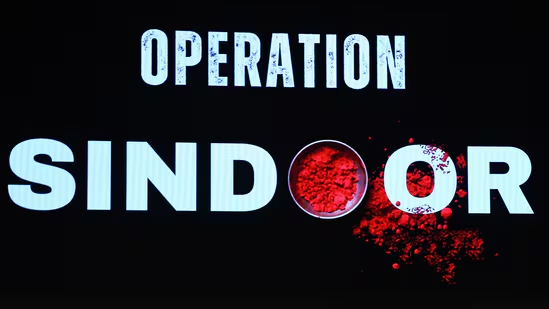
India’s DGMO Media Conference: “Operation Sindoor” 14 Oct 2025
The recent media conference held on October 14, 2025, by India’s Director General of Military Operations (DGMO), Lieutenant General Rajiv Ghai, provided a comprehensive briefing on Operation Sindoor—India’s formidable military response to the deadly Pahalgam terror attack. Further enriching the discussion, the conference revisited India’s past surgical strikes, framing these actions within a larger narrative of India’s evolving doctrine of deterrence and proactive counter-terrorism.
Operation Sindoor: India’s Decisive Call to Action
Operation Sindoor was precipitated by a brutal terror attack in Pahalgam, Jammu and Kashmir, killing 26 civilians, shaking the nation’s conscience. India’s response was swift, methodical, and resolute. The Indian Armed Forces orchestrated a carefully planned military operation, utilizing precise intelligence and joint service coordination to target terror camps, infrastructure, and logistic nodes along the Line of Control (LoC).
Lt Gen Ghai detailed that the operation, spanning 88 hours, focused on delivering a calculated blow to terrorists and their facilitators while maintaining a calibrated posture to avoid escalation beyond defensive objectives. This operation underscored India’s enhanced capability to project power swiftly in response to asymmetric threats.
India’s Surgical Strikes
Operation Sindoor aligns with India’s broader strategic doctrine exemplified in prior surgical strikes and counter-terrorism actions. These earlier operations laid the groundwork, demonstrating evolving operational readiness and the capacity to conduct cross-border punitive actions effectively.
- 2016 Surgical Strikes (September 29–30): Following the Uri attack on an army base, India launched surgical strikes targeting terrorist launch pads across the LoC. These operations inflicted significant casualties on terrorist groups within Pakistani-administered Kashmir, signaling a new level of Indian military assertiveness.
- 2018 Balakot Airstrikes (February 26): In response to the Pulwama suicide bombing, the Indian Air Force conducted air strikes deep within Pakistan’s Balakot region, targeting a terror camp run by Jaish-e-Mohammed. This marked the first time since 1971 that Indian air assets struck so far across the border.
Lt Gen Ghai referenced these operations during the briefing to highlight how such targeted strikes have become integral to India’s deterrence strategy, shaping enemy perceptions and defining clear red lines against cross-border terrorism.
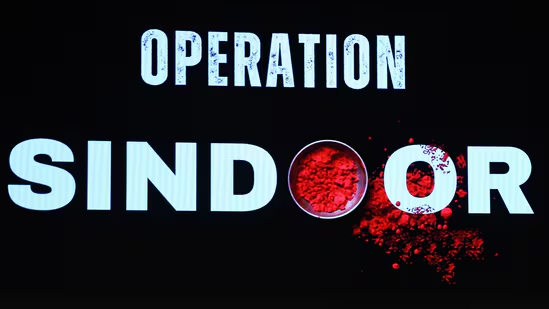
Operation Sindoor: Comprehensive Military Impact
The concentrated strikes of Operation Sindoor achieved significant tactical outcomes:
- Neutralization of Over 100 Pakistani Soldiers and More Than 100 Terrorists: Indian forces executed coordinated attacks on nine terrorist camps and logistic hubs, disrupting enemy command and control along the LoC.
- Air Strikes on Aerospace Assets: The Indian Air Force crippled eight air bases, destroyed hangars, radar installations, and took out multiple aircraft, including critical transport and fighter jets, severely degrading Pakistan’s aerial capabilities.
- Defensive Air Interceptions: Employing indigenous Akash missile systems and AI-enhanced counter-drone technologies, Indian defenses intercepted numerous hostile aerial threats such as drones, loitering munitions, and rocket barrages, ensuring critical territorial integrity.
Pursuit and Justice
India’s commitment extended beyond immediate retaliation. Over a 96-day campaign, Indian forces tracked and eliminated terrorist masterminds responsible for the Pahalgam attack, emphasizing relentless pursuit of justice. This operation reaffirmed the Indian Army’s doctrine of not just striking back but neutralizing threats preemptively.
Technological Edge and Modern Warfare
India’s military modernization was a recurring theme in the briefing. The integration of AI technologies, surveillance drones, real-time data fusion, and indigenous missile defense systems like Akash have revolutionized India’s operational capabilities. Lt Gen Ghai underscored how these advancements enhanced situational awareness, precision targeting, and adaptive defense, particularly relevant in asymmetrical warfare along contested borders.
Inter-Service Collaboration and Strategic Policy
The success of Operation Sindoor rested on unprecedented coordination among the Army, Navy, and Air Force bolstered by clear policy directives from the Government of India. This synergy allowed rapid mobilization, flexible operational planning, and seamless execution, eliminating traditional bureaucratic delays.
The DGMO stressed how such inter-service integration is now a cornerstone of India’s defense readiness, enabling simultaneous offensive and defensive postures and reinforcing a credible deterrence framework.
Communication, Public Reassurance, and Strategic Messaging
Lt Gen Ghai emphasized transparency and clarity in India’s strategic communications. Using effective analogies, he conveyed the rationale behind India’s actions—that India’s military responses are judicious, restrained, and aimed solely at deterring terrorism and protecting citizens. The message was clear: India seeks peace but will respond decisively to threats.
India’s Evolving Doctrine: From Surgical Strikes to Proactive Defense
Operation Sindoor and the earlier surgical and air strikes illustrate India’s shift from reactive postures to proactive defense. This doctrine involves:
- Rapid, targeted cross-border responses to terrorist provocations.
- Integration of advanced technology for enhanced battlefield awareness.
- Sustained intelligence-driven operations to dismantle terror infrastructure.
- Strategic messaging to communicate India’s resolve to foreign and domestic audiences.
This evolution strengthens India’s standing as a regional power committed to safeguarding its sovereignty amid a complex security environment.
The DGMO media conference on October 14, 2025, exemplified the transformation in India’s military strategy and operational capability. Operation Sindoor, set within the continuum of surgical strikes and air operations over the past decade, highlights the Indian Armed Forces’ readiness to confront terrorism with precision, technology, and inter-service synergy.
As India continues to modernize and integrate AI and indigenous defense systems, its ability to preempt threats and maintain peace through strength is firmly established. This briefing cemented India’s resolve: vigilant, capable, and steadfast in protecting its citizens and territorial integrity.
Date of Briefing: October 14, 2025